Airport Collaborative Decision Making (A-CDM)
Airport Collaborative Decision Making (A-CDM) is implemented within Khaleej vACC to improve departure predictability, reduce apron congestion, and support efficient traffic flow during both normal and high-density operations.
The system is designed to:
- Improve controller situational awareness
- Reduce unnecessary frequency congestion
- Support structured departure sequencing
- Improve realism during major events
- Prevent excessive taxiway saturation
- Ensure equitable startup allocation
When Should A-CDM Be Used?
A-CDM procedures should normally be considered active when:
- Departure demand exceeds practical aerodrome capacity
- Major events are in progress
- Significant outbound congestion is expected
- CTOT restrictions are in effect
- Controller workload requires structured sequencing
During low traffic periods, controllers may apply A-CDM procedures as required.
Definitions
Estimated Off-Block Time (EOBT)
General estimate as to when an aircraft will be ready to start-up or push-back. This is filed in a pilots flightplan.
Note
Do note that the TOBT is more accurate as it may be updated, whereas the EOBT is static.
Target Off-Block Time (TOBT)
The time aircraft operators estimate that the aircraft will be fully ready for immediate startup or pushback.
This includes:
- Boarding complete
- Doors closed
- Boarding bridge removed
- Push vehicle connected and ready
- Aircraft prepared for immediate movement
Target Start-Up Approval Time (TSAT)
Calculated time at which start-up approval can reasonably be expected.
TSAT considers multiple operational factors, including:
- Departure demand
- Taxi congestion
- Runway capacity
- CTOT restrictions
- Variable taxi times
- Apron saturation
Important
Pilots DO know their EOBT and TOBT, however pilots DO NOT know their assigned TSAT unless advised by ATC.
Controller Responsibilities
Clearance Delivery (DEL)
DEL controllers are responsible for:
- Managing TOBT compliance
- Issuing TSAT information
- Sequencing startup requests
- Monitoring delayed or non-responsive aircraft
- Coordinating CTOT restrictions
- Maintaining orderly startup flow
Ground (GND)
Ground controllers are responsible for:
- Maintaining efficient apron flow
- Preventing taxiway congestion
- Sequencing pushbacks strategically
- Coordinating apron conflicts
- Managing stand blockage issues
- Supporting departure flow continuity
Tower (TWR)
Tower controllers are responsible for:
- Maintaining departure spacing
- Coordinating arrival and departure balance
- Supporting continuous movement flow
- Applying wake turbulence efficiency
Using A-CDM
Figure 1.1

- Locate the following panel and click on the respective airport to enable CDM as a master user.
Figure 1.2
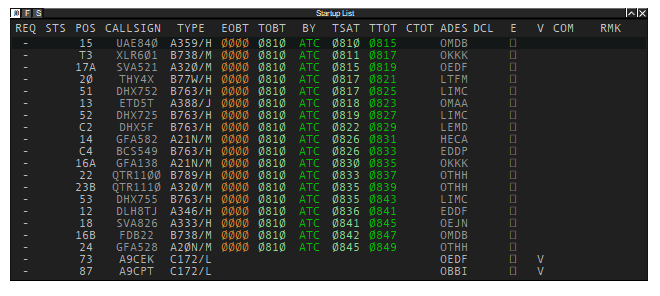
- Expand your Start-Up list; it will appear as shown above.
- If the list is not visible, open it via Quick Settings.
- When CDM is active, pilots are expected to submit their TOBT via the VDGS Dashboard.
- TSAT is automatically generated using operational conditions affecting aerodrome efficiency.
Controllers should provide TSAT information using the following phraseology:
DLV Controller:
“GFA138, readback correct. Expect push at time 0830z.”
Startup Sequencing Philosophy
Controllers should prioritise overall traffic flow efficiency rather than first-call priority alone.
Operational considerations may include:
- Taxiway congestion
- Stand blockage
- Departure direction
- CTOT restrictions
- Apron saturation
During periods of high demand, startups may be released in controlled batches to reduce congestion and improve taxi flow.
Operational Techniques
Startup Batching
During periods of high traffic demand, startups may be released in controlled groups to reduce apron congestion and excessive taxi delays.
Directional Sequencing
Aircraft may be grouped by SID direction or runway exit point to improve runway efficiency and reduce crossing conflicts.
Congestion Control
Ground controllers may temporarily suspend pushback approvals when taxiway saturation becomes excessive.
Stand Protection
Aircraft occupying operationally critical stands may receive priority startup approval where operationally necessary.
CDM Management Responsibility
Only DEL, or FMP/Planner if online, should operate CDM as a master user.
All other controllers should use:
.cdm slave [ICAO]
This ensures startup sequencing remains coordinated and predictable.
Common Controller Errors
The following issues commonly reduce operational efficiency during high-density operations:
- Issuing startup too early
- Excessive simultaneous pushbacks
- Overloading taxiways
- Forgetting missed TSAT resequencing
- Poor DEL/GND coordination
- Prioritising first-call over traffic flow
- Ignoring stand blockage impacts
Example Scenarios
Missed TSAT
Aircraft reports ready after assigned TSAT.
Recommended controller actions:
- Remove aircraft from original sequence
- Recalculate startup opportunity
- Issue revised TSAT
- Resequence according to current demand
Apron Saturation
Taxiways approaching practical capacity.
Recommended controller actions:
- Suspend additional push approvals
- Release aircraft in controlled batches
- Prioritise blocked stands where practical
- Coordinate with DEL to add an additional delay for pushbacks
Arrival Manager (AMAN)
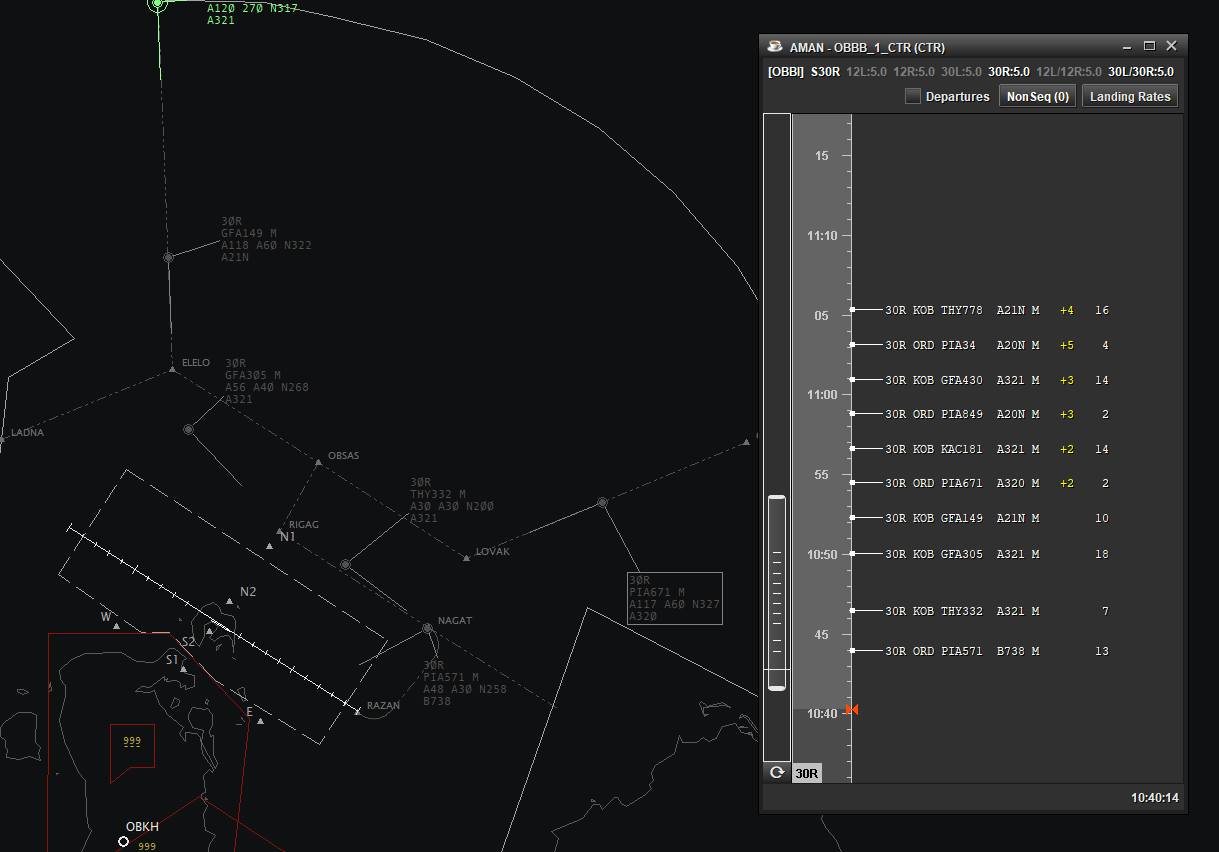
The Arrival Manager (AMAN) is a tactical sequencing aid controllers and flow managers may utilise during periods of increased arrival demand.
Controllers remain responsible
AMAN exists to support controller decision-making and sequencing awareness.
It shall not be relied upon as a replacement for controller judgement.
2.1 - EXAMPLE OF AMAN USAGE
Key Principles
- Predictability over speed
- Flow over individual priority
- Prevention over recovery
- Structured sequencing reduces workload
- Efficient ground movement improves runway throughput
- Early coordination prevents saturation