Bahrain Ground [OBBI_GND]
Amendment History
| Revision | Effective Date | Notes |
|---|---|---|
| Version 1 | 13AUG25 | Initial Publication |
| Version 2 | 30OCT25 | Revision #1 |
| Version 3 | 07MAY26 | Revision #2 |
Abbreviations
| Abbreviation | Meaning |
|---|---|
| GMC | Ground Movement Controller |
| TWR | Aerodrome Controller |
| DLV | Delivery Controller |
| LVP | Low Visibility Procedures |
| RVR | Runway Visual Range |
Chapter 1. Position Overview
Bahrain Ground (GMC) is responsible for the movement of aircraft on the airfields aprons and taxiways. The GMC Controller will provide aircraft with pushback instructions when required. Aircraft should be transferred to the TWR Controller once clear of all potential ground conflicts and approaching the runway holding point. Arriving aircraft will be taxied to a stand on an appropriate apron.
In the absence of the DLV Controller the GMC Controller will take on those roles and responsibilities.
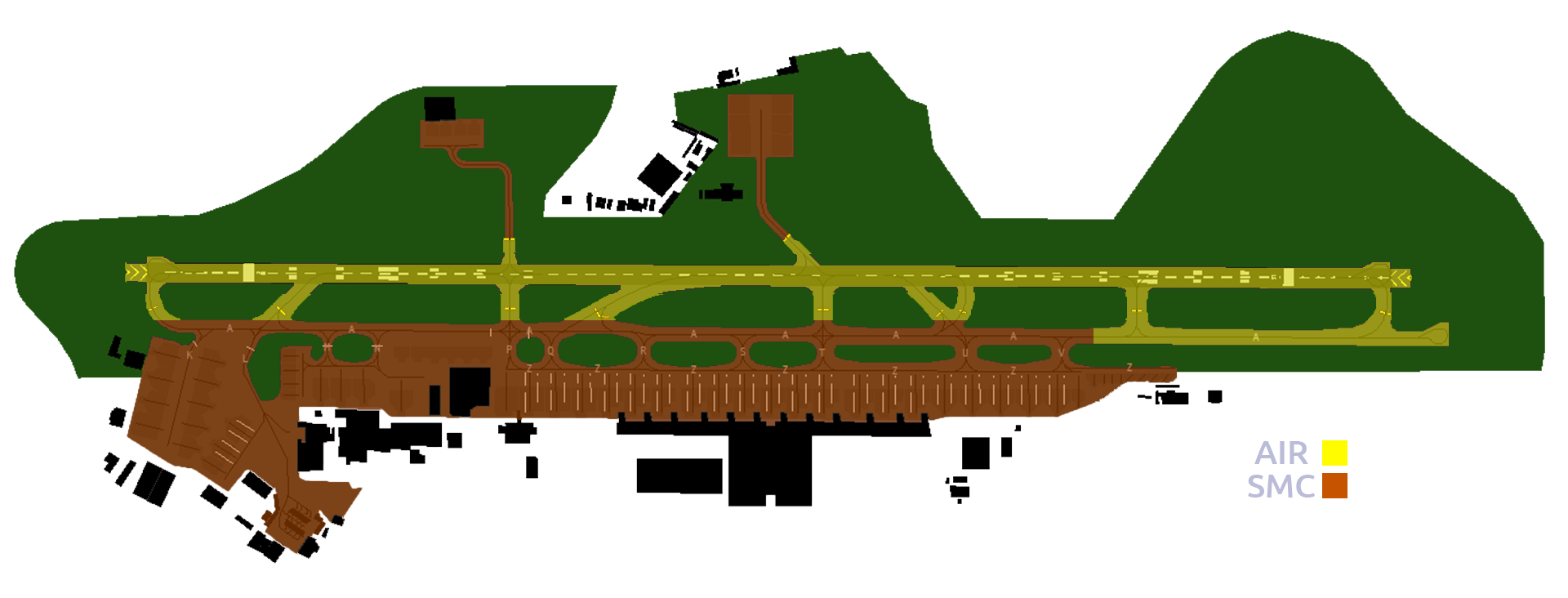
1.1 - AREA OF RESPONSIBILITY (30R Config)
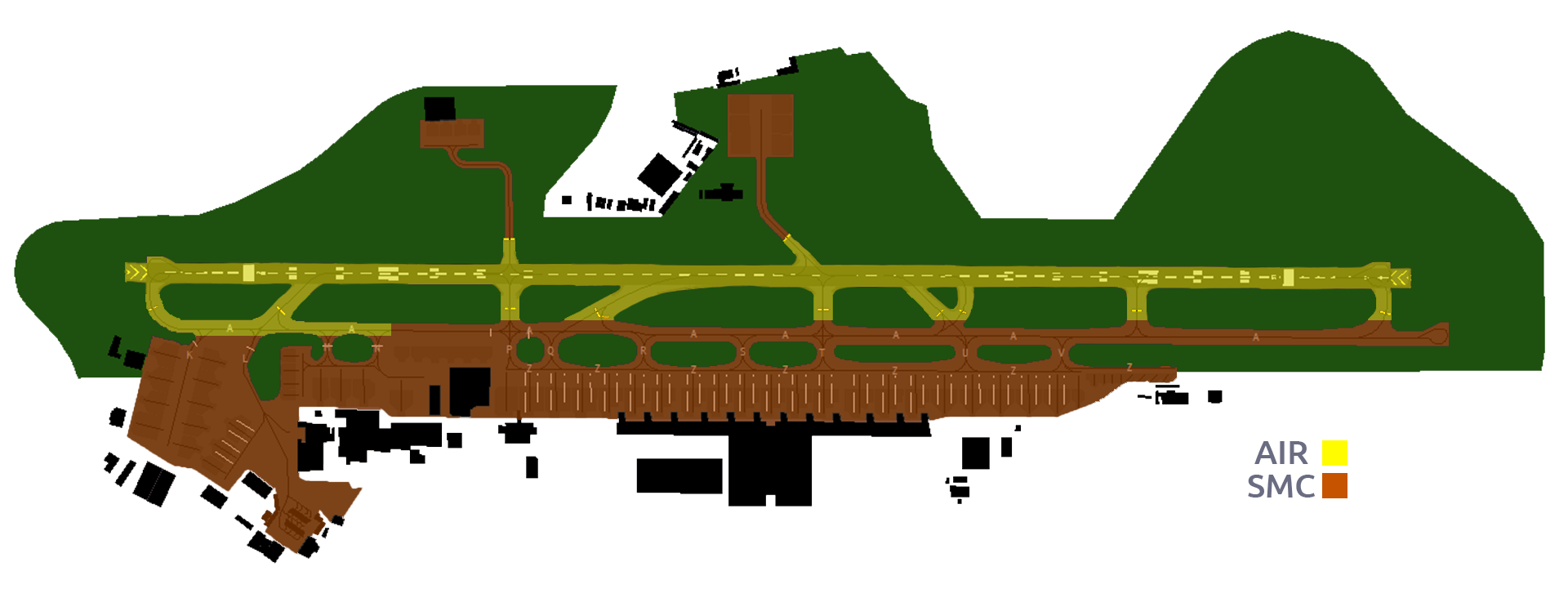
1.2 - AREA OF RESPONSIBILITY (12L Config)
Chapter 2. GEN | General Operating Procedures
2.1 Pushback Clearance
The GMC Controller is responsible for providing departing aircraft with a pushback clearance. Prior to issuing a pushback clearance, the aircraft should have correctly set its assigned squawk code. Pushback clearance must include the stand number of the aircraft being given clearance. This method is to ensure other nearby aircraft are aware of the movement from the stand onto a live taxiway. The QNH must be provided on the pushback clearance as well.
Example:
GMC Controller: "GFA250, stand 22, Push and start approved, face west, QNH1022"
Once the pushback clearance has been issued the GMC Controller should ensure they update the tag to provide all controllers with additional situational awareness.
Pushback clearances must only be issued when it is safe to do so and the area into which the aircraft has been cleared to push to is clear of all obstructions.
2.1.1 Conditional Pushback Clearance
In some cases you may have an inbound aircraft taxiing to a stand on the apron which passes behind the aircraft on stand requesting push and start. In order to ensure a constant flow of traffic the GMC Controller can provide the aircraft requesting push and start with a Conditional Pushback Clearance.
Example:
GMC Controller: "GFA250, behind the Emirates Airbus A350 passing right to left, stand 22, push and start approved, face west, QNH 1022."
2.1.2 Simultaneous Pushback Operations
Simultaneous Pushback Operations can be conducted at Bahrain. The aim of this process is that once both aircraft have completed their pushback procedures, they will be in position on the active taxiway with at least one stand between them. If aircraft are on adjacent stands and both requesting push and start it is best practice for each aircraft to push in opposite directions to prevent ground collisions.
2.1.3 Readback Requirements
Pilots must read back all pushback clearances, taxi instructions, hold short instructions, and runway crossing clearances in full.
2.2 Taxi Procedures
2.2.1 Departure Taxi Procedures
Once an aircraft has successfully completed push and start they will request taxi to the departing runway. It is the responsibility of the GMC Controller to provide that aircraft with a safe and efficient taxi instruction from the apron to the departure runway holding point.
2.2.1.1 Runway 30R Departure Configuration
Aircraft will be taxied out from their respective apron at the most convenient point to enter Taxiway A to depart full length from holding point A9 for Runway 30R. If requested by the pilot and traffic permitting intersection departures can be offered to reduce taxi times.
Example:
GMC Controller: "GFA500, Taxi to holding point A9 Runway 30R, via Zulu, Tango and Alpha."
Be Helpful
Some pilots may require assistance taxiing around the airfield, you can provide them with progressive taxi instructions if needed.
2.2.1.2 Runway 12L Departure Configuration
Aircraft will be taxied out from their respective apron at the most convenient point to enter Taxiway A to depart full length from holding point A1 for Runway 12L. If requested by the pilot and traffic permitting intersection departures can be offered to reduce taxi times.
GMC Controller: "GFA500, Taxi to holding point A1 Runway 12L, via Zulu, Tango and Alpha."
2.2.2 Intersection Departures
Intersection Departures can be utilised when the pilot requests it specifically. The GMC Controller is not allowed to instruct an intersection departure to a pilot without it being requested.
| Runway | Intersections |
|---|---|
| 30R | A8, A7, A5 |
| 12L | A2, A3 |
2.2.3 Northside Aprons
Aircraft parked on either the Northern Apron or the Texel Apron on the North Side of the airport will be expected to be taxied to B1 or B2, then transferred to the TWR controller for runway crossing. Once they have successfully been taxied from the North Side to the South Side and crossed the active runway they will be handed back to the GMC Controller to be taxied to the active runway for departure.
GMC Controller: "CNV1222, taxi holding point B2 Runway 30R for crossing."
Once the aircraft has reached the designated holding point for runway crossing they will be handed over to the TWR Controller who will sequence the aircraft appropriately for runway crossing.
GMC Controller: "CNV1222, Contact Bahrain Tower 118.500 for runway crossing."
Once the TWR Controller has successfully got the aircraft across the active runway they will be handed back to the GMC Controller who will then taxi them to the appropriate runway holding point.
2.2.4 Arrival Taxi Procedures
| Runway | Preferred Vacate Point |
|---|---|
| 30R | A4 |
| 12L | A6 |
2.2.4.1 Runway 30R Arrival Configuration
Aircraft landing on Runway 30R will be expected to vacate the runway at A4, TWR will not immediately hand over the aircraft to the GMC Controller to prevent aircraft holding after vacating and potentially blocking the preferential exit point further leading to the runway being obstructed. Aircraft will initially be told to taxi onto Taxiway A by the TWR Controller and then to contact the GMC Controller. It is vitally important that the GMC Controller ensures a stand has been allocated when the aircraft is on final approach so the TWR can see whether the inbound aircraft shall vacate the runway and turn right or left onto Taxiway A.
Once the aircraft has been transferred to the GMC Controller by TWR it is then the responsibility of the GMC Controller to safely and efficiently move the aircraft from the taxiway to his assigned stand taking into consideration the situation on the ground.
Not Approved
Aircraft landing on Runway 30R shall not vacate via A6 and/or A7.
GMC Controller: "GFA567, Welcome to Bahrain, Taxi via Quebec and Zulu to Stand 13."
2.2.4.2 Runway 12L Arrival Configuration
Aircraft landing on Runway 12L will be expected to vacate the runway at A6, TWR will not immediately hand over the aircraft to the GMC Controller to prevent aircraft holding after vacating and potentially blocking the preferential exit point further leading to the runway being obstructed. Aircraft will initially be told to taxi onto Taxiway A by the TWR Controller and then to contact the GMC Controller. It is vitally important that the GMC Controller ensures a stand has been allocated when the aircraft is on final approach so the TWR can see whether the inbound aircraft shall vacate the runway and turn right or left onto Taxiway A.
Once the aircraft has been transferred to the GMC Controller by TWR, it then becomes the responsibility of the GMC Controller to safely and efficiently move the aircraft from the taxiway to his assigned stand taking into consideration the situation on the ground.
Not Approved
Aircraft landing on Runway 12L shall not vacate via A4.
GMC Controller: "GFA567, Welcome to Bahrain, Taxi via Alpha, Tango and Zulu to Stand 19."
2.2.5 Conditional Taxi Instructions
In some cases aircraft may require a Conditional Taxi Instruction in order to facilitate for other movements on the ground and to ensure the safe movement of aircraft.
2.2.5.1 Conditional Departure Taxi Instructions
If the taxi route for a departing aircraft is not clear you can give them a conditional clearance to stop at a certain point along their taxi route to ensure they remain clear of any conflict.
GMC Controller: "DHX265, taxi via Kilo and Alpha, hold short of Taxiway Quebec, give way to Gulf Air 231 Airbus A321 crossing left to right at Quebec."
Once the route has cleared then they can be given the remainder of their taxi instructions as per normal general operating procedures outlined in Chapter 2.2
2.2.5.2 Conditional Arrival Taxi Instructions
Similarly, if an arriving aircraft does not have a clear route to their stand after vacating the runway a conditional clearance can be issued to ensure smooth flow of traffic in and out of the airfield. If issuing a conditional arrival taxi instruction you can provide the aircraft with their expected stand number.
GMC Controller: "DHX265, expect Stand 65, taxi via Alpha, hold short of Taxiway Tango, give way to the Gulf Air Airbus A320 exiting the apron at Tango."
2.2.6 Progressive Taxi Instructions
Progressive taxi instructions may be provided upon pilot request, during periods of low visibility, or whenever the controller believes additional assistance is required to ensure safe ground movement.
Example:
GMC Controller: "GFA221, progressive taxi approved, report ready to copy instructions."
2.3 Low Visibility Procedures (LVPs)
At Bahrain International Airport Runway 12L and Runway 30R are approved for CAT II operations in the event of LVPs.
Low Visibility Procedures will be declared when the RVR is reading 1000m or less, or whenever conditions are such that all the maneuvering area is not visible from the control tower.
2.3.1 Low Visibility Procedures - Departures
During LVPs, intersection departures are not authorised for both Runway 12L or Runway 30R.
2.3.2 Low Visibility Procedures - Arrivals
During LVPs, aircraft arriving on Runway 12L may only exit the RWY to the South of taxiway A5 or beyond or arriving aircraft may exit to the North at taxiway B1 or taxiway B2.
2.3.3 Low Visibility Procedures - Ground Movements
During Low Visibility Procedures, controllers should minimise complex taxi routings and avoid simultaneous taxi movements where practical. complex taxi routings and avoid simultaneous taxi movements where practical.
Progressive taxi instructions should be provided whenever necessary to ensure the safe movement of aircraft on the manoeuvring area.
2.4 Stand Allocation
| Apron | Stand Numbers | Airlines |
|---|---|---|
| Western Apron (A) | 61A - 63 | Non-Revenue / Maintenance Flights |
| Western Apron (B) | 50 - 58 | DHX / TXL / DHK (B767) / BCS |
| Executive Apron | E1 - E4 | Business Jets |
| Cargo Apron | C1 - C5 | DHX / DHK / BOX / BCS |
| Middle Apron | 1 - 6 | DHK / BOX / General Aviation |
| Main Apron (A) | 1 - 14 | All Commercial Airlines |
| Main Apron (B) | 15 - 24 | All Commercial Airlines |
| Main Apron (C) | 25 - 28 | All Commercial Airlines |
| Northern Apron | 70 - 75 | US Air Force / RAF / TXL |
| Texel Apron | N/A | TXL |