Kuwait Tower [OKKK_TWR]
Amendment History
| Revision | Effective Date | Notes |
|---|---|---|
| Version 1 | 13AUG25 | Initial Publication |
| Version 2 | 30OCT25 | Revision #1 |
| Version 3 | 07MAY26 | Revision #2 |
Chapter 1. Position Overview
Kuwait Tower (Tower) controls movement of aircraft on the runway and holding at all runway holding points. In addition to this the Tower Controller also has the responsibility of all aircraft within the Class D Kuwait Control Zone and shall ensure separation within the Control Zone (CTR) between IFR traffic is maintained for flights arriving and departing Kuwait. Traffic Information is provided between IFR and VFR Flights as well as VFR to IFR Flights within the Control Zone (CTR)
The Tower Controller is responsible for selecting the active runways for arrivals and departures at Kuwait and holds full authority over the runway.
Chapter 2. Airspace
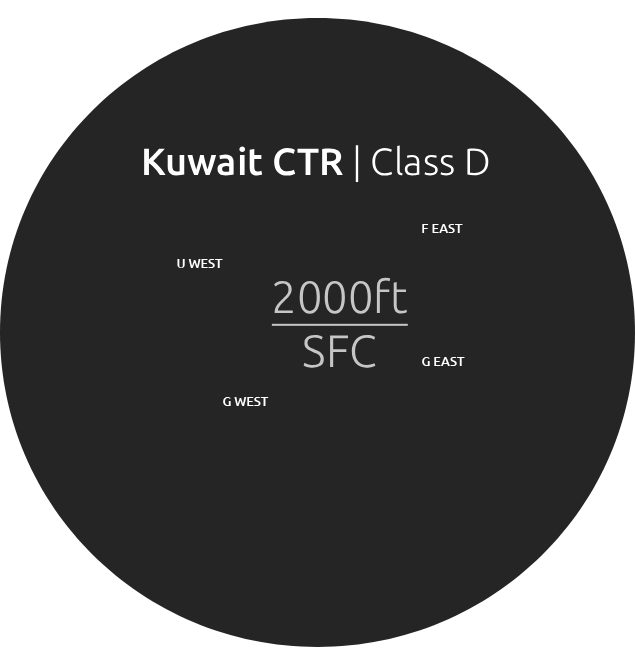
The Kuwait Control Zone (CTR) is Class D Airspace from the Ground up to 2000 ft Mean Sea Level (MSL). The Tower Controller is responsible for ensuring all traffic within the Control Zone are separated. This will typically include all IFR Flights departing and arriving as well as VFR Flights operating within the Control Zone or entering and exiting.
Chapter 3. GEN | Standard Operating Procedures
3.1 Runway Selection
At Kuwait International Airport (OKKK), the preferential runway is 34 for arrivals and 33L for departures which may be utilised with a tailwind of up to 5kts. If the tailwind component is greater than 5kts then the 15/16 config should be used for arrivals and departures. If the 15s have to be utilised then 15R is the favoured departure runway and 16 is used for arrivals. Runway 34/16 should be used for those parked in the Cargo City Aprons.
References to Use
-
You can always reference real world sources! However, this should NEVER become a reliance. NOTAMs should be read in the case there are runway closures/maintenance to simulate realism.
-
All Controllers should bear the ability to read weather and make an assessment on what the active runway in use should be. Additional information of reading METAR information can be found under the vMATS.
3.1.1 Runway Change
If the Tower Controller deems it necessary to change the active runway due to a change in wind direction this should be coordinated with all controllers above and below as this changes departure and arrival clearances. This should not be done suddenly, it must be carefully coordinated. The Approach Controller and Tower Controller will carefully select which aircraft is the last aircraft to land prior to the runway change.
This process is the same with the DLV or GMC Controller if an aircraft is already taxing to the active runway prior to runway change it may be less disruptive to allow the aircraft to depart if they can accept the tailwind. Aircraft can be re-issued with a departure clearance.
3.2 Line Up Procedures
The Tower Controller must issue clear and precise instructions when issuing aircraft with an instruction to line up on the active runway. There should be no delay and must include the following information:
- The Correct Runway Designator.
- The Holding Point at which the aircraft is to enter the runway by.
- Any relevant traffic information.
Example:
Tower Controller: "KAC501, via W1, line up and wait Runway 33L."
3.2.1 Conditional Line Up Clearance (Landing Traffic)
The Tower Controller may issue a conditional line up clearance in order to maximise movements and runway efficiency. This must be done efficiently and precisely.
Example:
Tower Controller: "KAC501, Behind landing Qatar Airways A320, via W1, line up and wait Runway 33L, behind."
Vitally Important
The use of the word "behind" at the start and end of the instruction is compulsory, this is to ensure the aircraft fully understands they are to give way to the landing traffic
3.2.2 Conditional Line Up Clearance (Departing Traffic)
The Tower Controller can also issue a conditional line up clearance for traffic waiting to depart behind a departing aircraft ahead of him. Again, this must be done efficiently and precisely to prevent any runway incursions or misunderstanding.
Example:
Tower Controller: "KAC501, behind the departing Company A330, via W1, line up and wait Runway 33L, behind"
Company Traffic
The use of the word company traffic in clearances can be used if the traffic related to the instruction is of the same company that is receiving the clearance.
3.2.3 Runway Safety
The Tower Controller must ensure that no runway crossing, line up or takeoff clearance is issued if there is any uncertainty regarding runway occupancy or aircraft position.
Controllers should make positive visual or radar confirmation where available before issuing runway entry instructions.
Particular care should be taken during: - Conditional clearances - Low visibility operations - Multiple aircraft holding at different intersections - Simultaneous runway crossings - Runway changes
If there is any doubt regarding an aircraft’s position, the clearance shall be withheld until clarification has been obtained.
3.3 Take Off Procedures
3.3.1 Standard Instrument Departures (SIDs)
All departures from Kuwait will be assigned a Standard Instrument Departure (SID) when they receive their departure clearance, they are assigned based on the first waypoint in their flight plan and/or direction of flight. The purpose of SIDs is to enhance safety, predictability and efficiently guide traffic from their initial departure phase to the en-route traffic environment.
All SIDs in Kuwait are RNAV1 (Area Navigation) which means aircraft must be able to maintain a total system error of no more than 1 nautical mile (NM) for 95% of the flight time. This enhances safety, and accuracy of the departure routing an aircraft should fly.
16:
| SID | Designator | Departure Runway |
|---|---|---|
| ALVAX | 1K | 16 |
| ASVIR | 1K | 16 |
| BOXIK | 1K | 16 |
| RALKA | 1K | 16 |
| SESRU | 1K | 16 |
| DEKOB | 1K | 16 |
| KATOD | 1K | 16 |
| NIDAP | 1K | 16 |
15R
| SID | Designator | Departure Runway |
|---|---|---|
| ALVAX | 5E | 15R |
| ASVIR | 5E | 15R |
| BOXIK | 5E | 15R |
| RALKA | 5E | 15R |
| SESRU | 5E | 15R |
| DEKOB | 1L | 15R |
| KATOD | 1L | 15R |
| NIDAP | 1L | 15R |
33L:
| SID | Designator | Departure Runway |
|---|---|---|
| ALVAX | 5F | 33L |
| ASVIR | 5F | 33L |
| BOXIK | 5F | 33L |
| TASMI | 5F | 33L |
| SESRU | 5F | 33L |
| DEKOB | 1J | 33L |
| KATOD | 1J | 33L |
| NIDAP | 1J | 33L |
34:
| SID | Designator | Departure Runway |
|---|---|---|
| ALVAX | 1I | 34 |
| ASVIR | 1I | 34 |
| BOXIK | 1I | 34 |
| TASMI | 1I | 34 |
| SESRU | 1I | 34 |
| DEKOB | 1I | 34 |
| KATOD | 1I | 34 |
| NIDAP | 1I | 34 |
The initial climb for all departures for aircraft assigned a Standard Instrument Departure (SID) is 4000 ft.
3.3.2 Take Off Clearances
Aircraft should only be given take off clearance once the runway is clear of obstructions and separation between any previously departed aircraft has been achieved.
Example:
Tower Controller: "KAC393, surface winds 300 Degrees at 12 knots, Runway 33L, cleared for takeoff."
3.3.3 Handing Off
Once the aircraft has taken off and a positive rate of climb can be seen (typically passing 800 ft) they should be informed to contact the Approach Controller with their passing altitude.
Example:
Tower Controller: "KAC393, contact Kuwait Approach 124.800."
3.3.4 Wake Separation
Time based separation is utilised at Kuwait to ensure separation between various wake turbulence categories is maintained. The Tower Controller is responsible for ensuring the separation system is enforced.
3.3.4.1 Wake Turbulence categories
Aircraft are divided into 4 different Wake Turbulence categories (WTC) based on the aircrafts certified Maximum Take Off Weight.
| Wake Turbulence Category (WTC) | Maximum Take Off Weight (MTOW) |
|---|---|
| Light (L) | ≤ 7000KG |
| Medium (M) | 7000KG to 136,000KG |
| Heavy (H) | ≥ 136,000KG |
| Super (J) | A388 ONLY |
It is the responsibility of the controller to check the Flight Plan (FPL) if they are unsure of an aircrafts Wake Turbulence Category.
3.3.4.2 Time Based Separation Table
| Preceding (Before) | Behind | Succeeding (After) | Separation Time | From an intersection |
|---|---|---|---|---|
| Light | Medium | 2 min | 3 min | |
| Medium | Heavy | 2 min | 3 min | |
| Light | Heavy | 2 min | 3 min | |
| Medium | Super | 3 min | 4 min | |
| Light | Super | 3 min | 4 min |
3.3.5 Stopping a Departure
In the event you are required to stop a departure after take off clearance has been issued you need to act fast. This can be to prevent a potential collision as a result of a runway incursion or due to a Go Around which is now in the flight path of the departing aircraft.
The instruction must be issued early enough so that the departing aircraft does not reach its "V1" (maximum speed at which a rejected takeoff can be initiated).
For stopping an aircraft that has already begun its take off roll the following phraseology should be used.
Example:
Tower Controller: "FDB687, stop immediately, I say again, stop immediately, runway incursion"
For an aircraft that has not yet begun the take off roll the following phraseology should be used:
Example:
Tower Controller: "FDB687, hold position, cancel take off, I say again, cancel take off due runway incursion"
3.4 Arrival Procedures
The Tower Controller is responsible for issuing traffic landing clearance. They must ensure that separation is maintained on the approach between all aircraft and that all arriving aircraft have a clear unobstructed runway with an issued clearance no later than 2 NM from touchdown.
3.4.1 Landing Clearance
Example:
Tower Controller: "JZR1144, surface winds 300 Degrees at 10 knots, Runway 34, cleared to land"
3.4.1.1 Late Landing Clearance
In the event traffic may be issued a late landing clearance due to traffic departing ahead of them or vacating slowly they can be issued a late landing clearance, however, the landing traffic must be issued a landing clearance no later than 2 NM from touchdown.
Tower Controller: "JZR1144, Expect late landing clearance, one to vacate ahead"
3.4.2 Preferred Exit Points
In order to ensure minimum runway occupancy time pilots are expected to vacate the active runway by the taxiways.
| Runway | Vacate Point |
|---|---|
| RWY 15L | E2 / Loop 1 / Loop 2 |
| RWY 15R | W2 / Loop 1 |
| RWY 33R | Loop 1 / Loop 2 |
| RWY 33L | W5 / Loop |
| RWY 34 | V4/V6 |
| RWY 16 | V7/V5 |
3.4.3 Vacating Traffic
Traffic vacating the active runway shall not be immediately transferred to the GMC Controller, it is the responsibility of the Tower Controller to issue an initial taxi clearance onto taxiway W1 or E1 to ensure the runway is not obstructed by aircraft stopping at the holding point and then waiting for an instruction from the GMC controller.
The aim is to ensure the runway is kept clear to allow smooth and efficient flow of traffic in and out of Kuwait International Airport (OKKK).
The GMC Controller (if online) has the responsibility to ensure all aircraft on final approach are allocated with a stand number, this allows the Tower Controller to be able to issue an initial taxi clearance after vacating the runway in the direction of that allocated parking stand.
3.4.3.1 After Landing Phraseology
Example:
Tower Controller: "IAW1017, continue taxi left V, hold short P, contact Kuwait Ground 121.850."
3.4.4 Separation Requirements
Within the Kuwait Control Zone (CTR) the Tower Controller is responsible for ensuring adequate separation exists between all traffic, this includes vertically and laterally to ensure safe and efficient operation.
3.4.4.1 Longitudinal Separation (Lateral)
Aircraft arriving into Kuwait should be separated by 7 NM laterally.
3.4.4.2 Speed Control
Though the Tower Controller is not able to issue aircraft with a measurement of speed they can advise aircraft to reduce to their minimum final approach speed if separation on the approach is starting to look like it may not work.
Example:
Tower Controller: "QTR1072, reduce to minimum approach speed"
3.4.4.3 Wake Turbulence Separation
Aircraft must also be suitable separated in accordance with their Wake Turbulence categories, much like departing aircraft to reduce the impact of wake produced by the preceding aircraft.
| Leader / Follower | Super (J) | Heavy (H) | Medium (M) | Light (L) |
|---|---|---|---|---|
| Super (J) | 6NM | 7NM | 8NM | |
| Heavy (H) | 4NM | 5NM | 6NM | |
| Medium (M) | 5NM | |||
| Light (L) |
3.4.5 Go Around Procedures
It is the responsibility of the Tower Controller to issue Go Around Instructions if the controller observes a loss of separation on the final approach or an obstruction on the runway that will not clear before the arriving aircraft meets the 2 NM clearance issued criteria.
Example:
Tower Controller: "KAC156, "Go Around, I say again, go around, acknowledge"
Once the aircraft has acknowledged the Go Around, the Tower Controller shall issue the aircraft which the standard missed approach phraseology.
Tower Controller: "KAC156, fly standard missed approach procedure, climb altitude 5000 ft, contact Kuwait Approach on 124.800"
Coordination
If a Go Around instruction has been issued, the Approach Controller should be notified immediately once the aircraft has been given instructions.
3.4.5.1 Go Around Coordination
Following a Go Around instruction, the Tower Controller shall immediately coordinate with the Approach Controller advising:
- Aircraft Callsign
- Runway
- Reason for the Go Around
- Any traffic information deemed relevant
The Tower Controller should ensure no conflicting departure clearances are issued until coordination with the Approach Controller has been completed.
3.4.6 Low Visibility Operations
During periods of reduced visibility, controllers should apply additional caution to all runway movements and minimise conditional clearances where possible.
Controllers should ensure: - Runway occupancy time is minimised - Clear and concise taxi instructions are issued - Aircraft positions are positively identified - Additional spacing is considered between arriving aircraft where necessary
Conditional line up clearances should only be used when the controller is fully satisfied that situational awareness can be maintained safely.
3.5 VFR Procedures
VFR departures should be given departure instructions, including turn directions and leg to exit the circuit (if appropriate), and altitude. Circuits shall be conducted in accordance with the following procedures: VFR aircraft shall be assigned an SSR code and taxied to their assigned runway (with concurrence of Tower) and shall receive departure instructions from Tower prior to departure.
Aircraft may request either touch and go, a stop and go, a low approach, or a full stop.
Once the Tower Controller is aware of the aircraft’s intentions within the control zone, they may be sequenced to the runway, with due consideration given to runway occupancy time.
The following information should be provided prior to joining the circuit: - Leg to join - Expected runway - Sequence - Any applicable traffic information
Callsign Shortening
With VFR Traffic you are allowed to abbreviate the callsign once contact has been established. Your first transmission with the aircraft must always include their full callsign however, from then on, you may abbreviate the callsign to 3 letters, this helps reduce frequency congestion.
3.5.1 Traffic remaining in VFR Circuit
VFR Circuits at OKKK (Kuwait International Airport) are carried out only on RWY 34 and RWY 16 in right/left hand circuits. Refer to the table below.
| Runway | Circuit Direction | Altitude (Piston) | Altitude (Jet) |
|---|---|---|---|
| 34 | Left-Hand | 1000 ft | 1500 ft |
| 16 | Right-Hand | 1000 ft | 1500 ft |
3.5.1.1 VFR Circuits phraseology
Pilot: "Kuwait Tower, 9K-SAA with you holding point W1, ready for departure"
Tower: "9K-SAA, after departure left hand turn out, via W1, cleared for takeoff Runway 33L, surface winds calm, QNH1019."
Pilot: "After departure left hand turn out, via W1, cleared for takeoff Runway 33L, 9K-SAA"
Once the aircraft is airborne and established on the left hand turn off you can advise them to report downwind with intentions.
Tower: "9-AA, report downwind runway 34 with intentions"
NOTE - RWY 33L departures integrate into RWY 34 visual circuit operations.
Pilot: "Wilco, 9-AA"
Pilot: "9-AA, right hand downwind RWY 34 for touch and go"
Tower: "9-AA, roger, you are number 2 to a Jazeera A320 on 3 NM final, maintain visual separation, caution wake turbulence, report final runway 34"
Pilot: "Traffic is in sight, maintaining visual separation, will report final runway 34, 9-AA"
Pilot: "9-AA, final runway 34"
Tower: "9-AA, cleared touch and go runway 34, winds calm, report downwind"
3.5.2 Zone Exit Clearances
VFR Flights planning to depart Kuwait International Airport (OKKK) to leave the Control Zone (CTR) must first have prior approval from the APP Controller to enter the Terminal Maneuvering Area (TMA). This is done through coordination by the Tower & Terminal controllers.
Pilot - "9K-SAA with you Apron 3 with information A on board, aircraft type C172 request clearance to leave the zone to the South"
Tower Controller: "9K-SAA, good afternoon, cleared to leave the zone to the south via Ahmadi not above altitude 1500 ft VFR, squawk 1011"
Pilot - "9K-SAA, cleared to leave the zone to the south via Ahmadi, not above altitude 1500 ft VFR, squawk 1011.
Tower Controller: "9K-SAA, readback correct information A is current QNH 1019 advise when ready for startup."
Pilot - "9K-SAA, wilco."
Once the pilot has taken off, and reports airborne, instruct them to leave the control routing westbound with a reporting instruction, as seen as in the example below:
Tower Controller: "9K-SAA, report one mile from leaving the control zone"
Pilot - "9K-SAA, wilco."
Pilot - "9K-SAA, one mile from exiting, 1500 ft VFR."
Tower Controller: "9K-SAA, you are leaving the control zone monitor advisory on 122.800."
If applicable, pilots entering the Class Charlie must be with Kuwait Approach (124.800) or higher. Coordination is mandatory.
3.5.3 Inbound VFR Traffic
Inbound VFR aircraft shall be sent to ADC with enough time such that two-way radio communications have been established before aircraft receive clearance to enter the aerodrome control zone.
On initial contact, ADC will pass the instructions for joining the circuit, as well as any other pertinent information such as traffic information with the sector.
During times of heavy IFR arrival activity, VFR arrivals may be denied entry into the control zone and instructed to hold outside of the CTR awaiting further instructions. Once a slot has been coordinated with the radar controllers, VFR arrivals may proceed, however, the estimated delay must be given to the pilot.
Pilot - "9K-SAA, with you 15 NM west of the airfield request clearance to enter the control zone."
Tower Controller: "9K-SAA, good afternoon, cleared to enter the control zone routing eastbound, not above altitude 1500 ft VFR, squawk 1057"
Pilot - "9K-SAA, cleared to enter the control zone routing eastbound, not above altitude 1500 ft VFR, squawk 1057"
Tower Controller: "9K-SAA, read back is correct, QNH 1019. Report when airfield is in-sight."
Pilot - "9K-SAA, QNH 1019, and wilco."
Pilot - "9K-SAA, airfield in-sight, requesting visual circuits runway 34."
Tower Controller: "9K-SAA, cleared to enter the left hand visual circuit Runway 34, not above altitude 1000 ft VFR, report downwind with intentions."
Pilot - "9K-SAA, cleared to enter the right hand visual circuit Runway 34, not above altitude 1000 ft VFR, we will report downwind with the intent."